Oolong Tea
Oolong tea is arguably the most craft-intensive of all teas. The name means «black dragon», and there is something dragon-like about it: the interplay of heat and coolness, of motion and stillness, of green and dark. Oolong teas sit between green and black tea — partially oxidised, anywhere from 10 % to over 80 %.
Their processing is among the most complex in the tea world: sun withering, indoor withering, shaking and tumbling in bamboo baskets to gently bruise the leaves and trigger oxidation, then pan-firing, rolling, drying — for many teas followed by an additional roasting over charcoal.
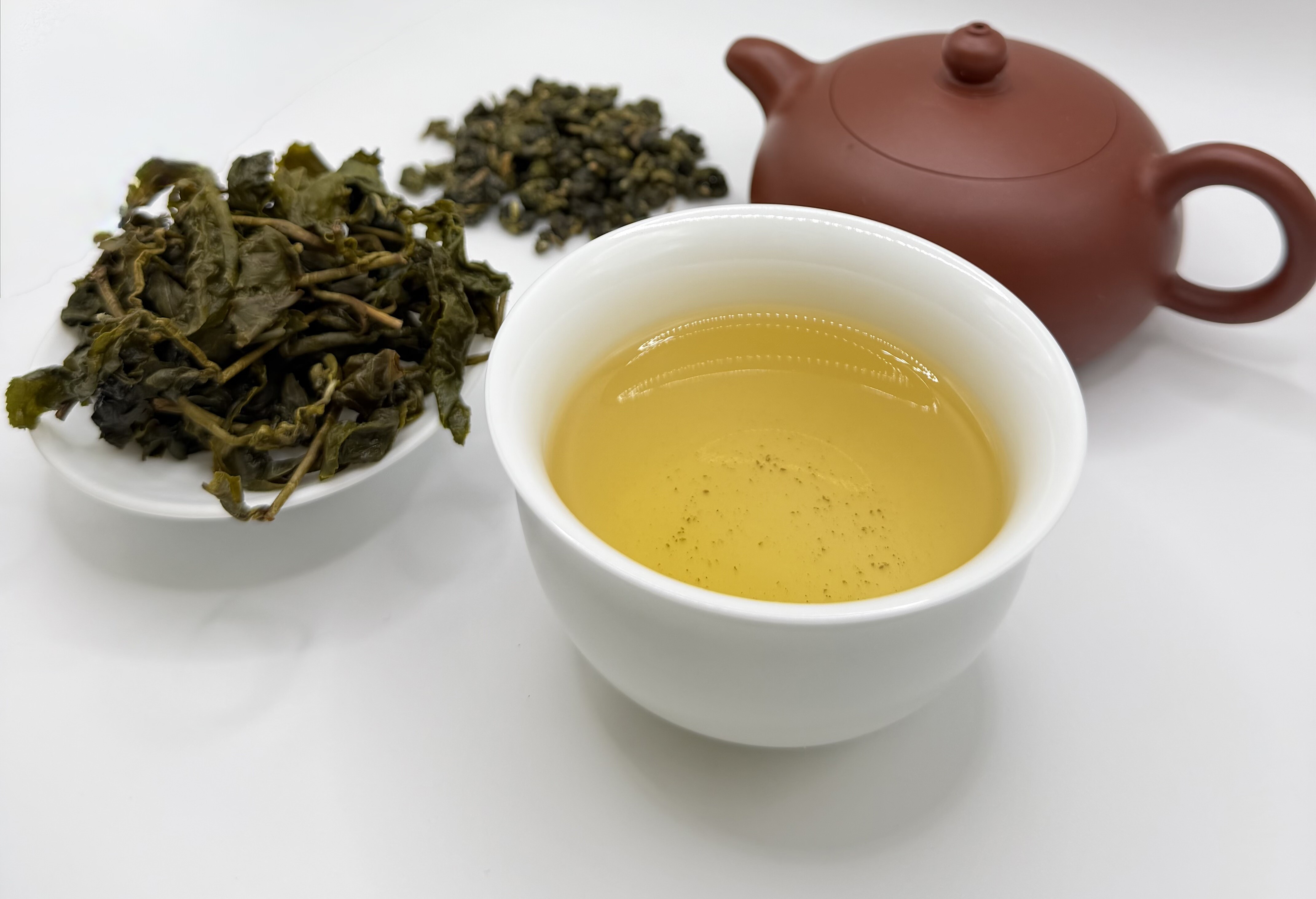
Two basic forms
• Dark open-leaf oolongs — 35–90 % oxidised. Long, open leaves; dark, full-bodied, with roasted and mineral notes. • Jade (balled) oolongs — 10–80 % oxidised. Rolled into small pellets; floral, creamy and green.
China — the three great oolong regions
Anxi County, Fujian — home of Tie Guan Yin
Tie Guan Yin («Tea of the Iron Goddess of Mercy») is the most famous rolled oolong in the world. Three classic styles define it:
• Green / lightly roasted style — fresh, floral, jasmine-like, with creamy sweetness. • Medium roasted — floral with toast-caramel notes. • Traditional dark roasted — complex, warm, dark, with notes of honey and roasted nuts.
Wuyi Mountains, Fujian — home of the rock oolongs
Since 1999, the Wuyi Mountains have been a UNESCO World Heritage Site. On their rocky slopes grow the famous Yan Cha («rock teas») — dark oolongs with a unique mineral, wet-stone character (in English «yanyun» or «petrichor»):
• Da Hong Pao (Big Red Robe) — The most famous rock oolong; tea from the legendary mother bushes can fetch up to USD 1 million per kilogram. 35–50 % oxidised, medium to heavy roast. Full-bodied, floral, woody, with a long sweet and slightly smoky finish. • Rou Gui (Cassia / Cinnamon) — With clear cinnamon and sweet-spicy notes. • Shui Xian (Water Sprite / Narcissus) — Caramel-honey character. • Shui Jin Gui (Golden Water Turtle) — Dark chocolate on the nose, floral-sweet on the palate.
Phoenix Mountains, Guangdong — home of the Dan Cong
Dan Cong («from a single tree») is a family of oolongs each produced from a single ancient tree or a small clump of bushes. More than 3,000 trees here are over 100 years old. Each Dan Cong has its own floral profile:
• Mi Lan Xiang («Honey Orchid Fragrance») — the most famous Dan Cong. • Gui Hua Xiang («Osmanthus Fragrance») • Ya Shi Xiang («Duck Shit Fragrance») — despite the name, a floral, apricot-like tea with raw-sugar sweetness.
Taiwan — the kingdom of modern oolong
Over the past 50 years, Taiwan has redefined the world of oolong. Though the island is barely larger than Switzerland, it is home to dozens of microclimates — and the high-mountain gardens above 1,000 metres («Gaoshan») produce some of the most sought-after teas in the world.
High-mountain jade oolong — From Ali Shan, Li Shan, Mei Shan and Lishan. Bright, creamy, intensely floral, with a freshness that only altitude and mist can produce.
Bao Zhong (Pouchong) — From the Wenshan region south of Taipei. At 8–12 % oxidation, the lightest, greenest oolong of all. Highly floral, with notes of lily and lily-of-the-valley.
Bagua Shan Dong Pian and Competition Bagua Shan — From the Bagua range, with a finely balanced roast and a creamy texture.
Jin Xuan / Milk Oolong («Milk Fragrance») — From the 1981-released cultivar No. 12. Naturally silky, with a buttery, almost milky texture and orchid notes — without any artificial milk flavouring.
Oriental Beauty (Dong Fang Mei Ren) and Bug Bitten — Perhaps the most unusual story: this tea only succeeds when the bushes have been bitten by tiny leafhoppers (Jacobiasca formosana). The insect bite triggers oxidation, while the plant produces defence compounds that give the tea its unmistakable honey-grape character. 60–65 % oxidised, rolled, with five visible colours in the dry leaf.
GABA Oolong — A modern speciality where the leaves are alternately exposed to air and nitrogen. Rich in gamma-aminobutyric acid (GABA); calming and sleep-supportive.
Pomelo Flower — A rare speciality: an oolong scented with pomelo blossoms — an example of how Chinese-Taiwanese tradition and scenting at source can merge.
Preparation
Oolong teas call for hot water and multiple short infusions — the ideal method is Gong Fu Cha with a gaiwan or Yixing pot:
• Water temperature: 90–100 °C • Western brewing: 2–3 g per 200 ml, 3 minutes • Gong Fu: 5–8 g per 100 ml, 20–40 seconds per infusion, 6–10 infusions possible
With every infusion, a good oolong reveals a new facet — perhaps the most beautiful lesson tea can teach us. Browse our full oolong selection.